visualizations
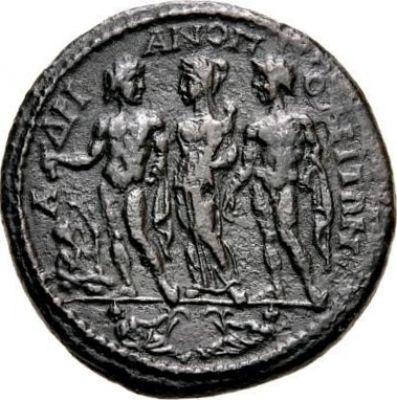
On the reverse of a bronze coin dated to the time of the Roman emperor Gordian III, Orestes, Iphigeneia, and Pylades are depicted from left to right. Orestes holds a patera (phiale, vessel for libations) and Iphigeneia a statuette of the goddess Artemis. On side and below are the three god-rivers: Arda, Hebrus, and Tonsus, holding reeds. The scene depicts the purification of Orestes from matricide in the conjunction of river Hebrus with its tributaries. His escape from the Taurian land is preceded and accompanied by his friend Pylades and his sister Iphigeneia. In the representation, the name of the Hadrianopolis citizen (ΑΔΡΙΑΝΟΠΟΛΕΙΤΩΝ) is read.
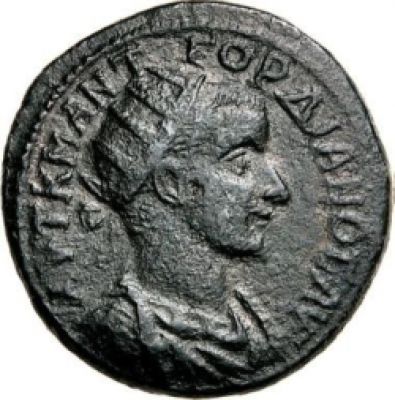
On the obverse, there is a portrait of the emperor Marcus Antonius Gordianus Augustus. There is also an inscription with his name (ΑΥΤ Κ Μ ΑΝΤ ΓΟΡΔΙΑΝΟC ΑΥΓ).
According to the myth, Orestes founded the city of Orestias on the site where he bathed and released by the Furies. When it became the capital of the Odrysians, a Thracian tribe, the city was renamed Ouskoudama and in 127 AD, it was named Hadrianopolis in honor of the Roman emperor Hadrian. After the Asia Minor Catastrophe and the Treaty of Lausanne, the Greek refugees who came from Hadrianopolis and more specifically from the suburb Karagatch, founded Nea Orestias on the opposite bank of Hebrus, in the regional unit of Evros.
Caption Bronze coin of Hadrianopolis depicting the purification of Orestes in the place where the rivers Arda, Hebrus and Tonsus meet
Mythic people Tundzha (River deity), Ardas (River deity), Pylades (Hero), Iphigenia (Heroine) ,Hebrus (God), Orestes (Hero)
Type Coin
Artist/Creator mint of Hadrianopolis
Origin Thrace
Dating 238-244 AD
Notes
Τύπος cn type 6547 | Corpus Nummorum (corpus-nummorum.eu)
Πληροφορίες για τη Νέα Ορεστιάδα και την ιστορία της, βλ. Ορεστιάδα - Βικιπαίδεια (wikipedia.org), και για την Αδριανούπολη, βλ. Information on the area ADRIANOUPOLIS - Greek Travel Pages (gtp.gr)

Related
Myths

Related
Points of interest

Partners