visualizations
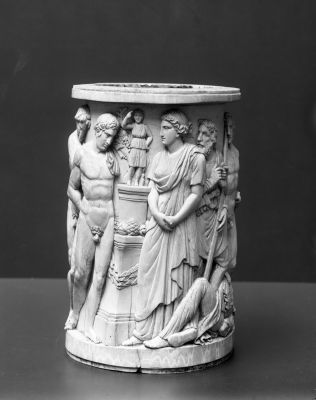
An ivory tankard with missing handles, feet, and cover, depicts Orestes and Pylades in the Land of Taurians. Iphigenia, the priestess of the goddess Artemis, stands right of the altar with the statuette of her. With their arms bound, Orestes and Pylades approach the altar and the priestess on the left. The other side depicts the discovery of Orestes' identity by his sister.
The ivory tankard was created by an Italian Neoclassical artist who replicated a Roman sarcophagus with Euripides' "Iphigenia in Tauris". The sarcophagus was acquired by Domenico Grimani in the 16th century and installed at the Grimani Palace in Santa Maria Formosa, Venice, before being acquiring by archduke Carl Alexander of Saxe-Weimar in 1834-1835. It is now on display at the Schlossmuseum in Weimar. The Neoclassicist artist seems to have reproduced the sarcophagus while still in Italy, adding decorative elements where there were lacunae and dismissing the episode of the fleeing from Tauris. The tankard was sold in 1880 as a 16th-century work and was purchased by the Walters Art Museum in 1931.
Caption Ivory tankard with Orestes, Pylades and Iphigenia in Tauris
Mythic people Pylades (Hero), Iphigenia (Heroine) ,Orestes (Hero)
Type Ivory object
Artist/Creator Venetian (?) atist
Origin Italy
Current position The Walters Art Museum, Baltimore (USA)
Index number 71.348
Dating 18th-19th c. AD.
Notes
Orestes and Pylades with Iphigenia in Tauris | The Walters Art Museum
Μορφές και Θέματα της Αρχαίας Ελληνικής Μυθολογίας (greek-language.gr)

Related
Myths

Partners